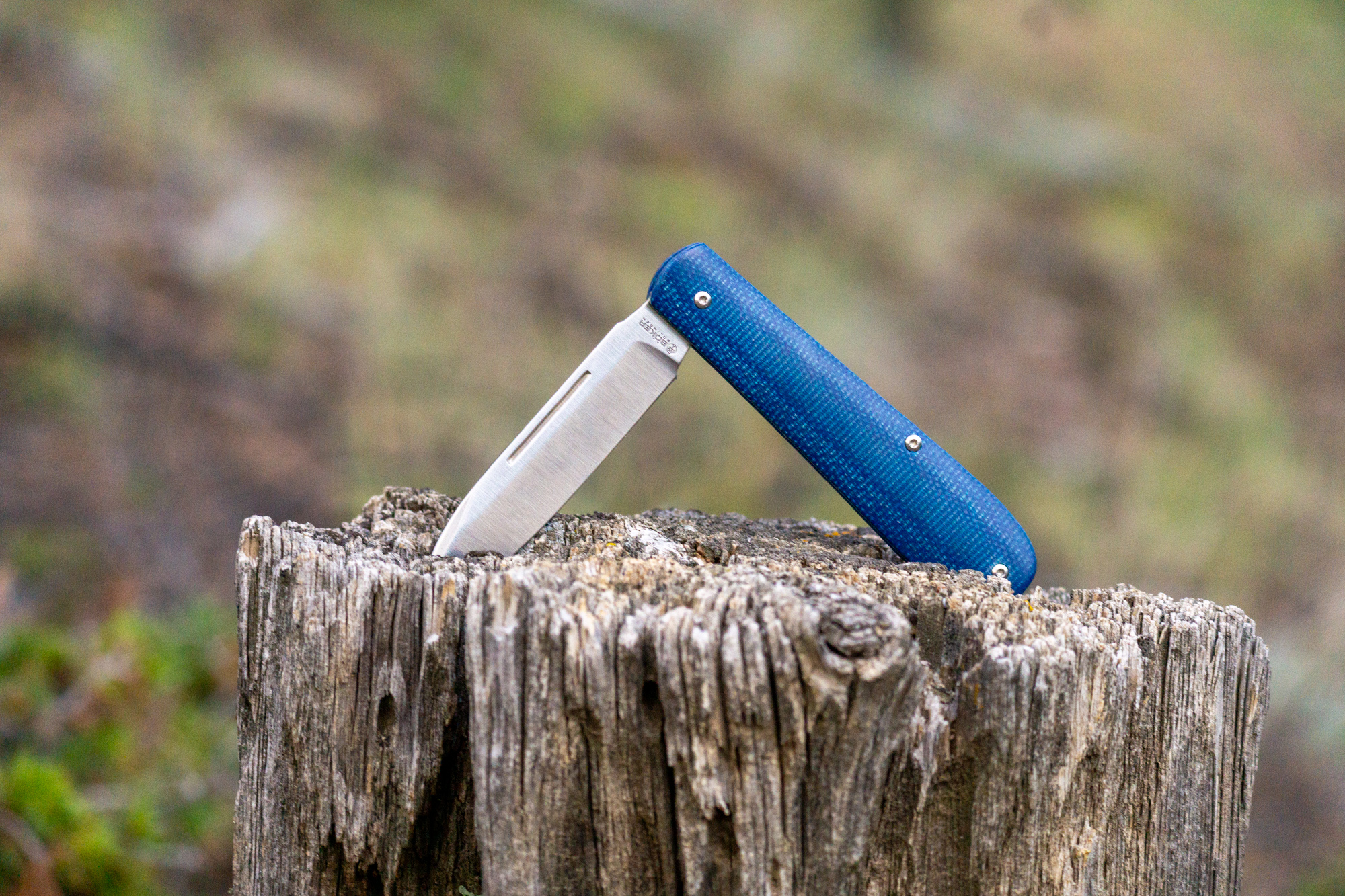
The Böker Coffin Denim Micarta is a German-made slipjoint that pairs an old-school, non-locking design with one of the best modern stainless steels you can buy. It’s not a hard-use tactical folder, and it doesn’t pretend to be. It’s a gentleman’s knife built tough enough for a life of adventure. Rachael and I are rarely found without a knife of some sort. Out here we cut a lot of small stuff: zip ties tearing down a trade show, cheese at camp, a stubborn blister pack at a gas station in the middle of nowhere. For that kind of work, a slim slipjoint often beats a chunky one-hand opener. The question is whether this one earns its price tag. Here’s our take.
Specifications at a glance
Item number | 112944 |
Price (MSRP) | $151.95 |
Designer | Chuck Gedraitis |
Blade steel | CPM MagnaCut, 61–62 HRC |
Blade length | 3.15 in |
Blade thickness | 0.10 in |
Overall length (open) | 7.36 in |
Weight | 1.98 oz |
Handle | Denim Micarta |
Lock | None (slipjoint, 90° half-stop) |
Opening | Manual, two-handed nail nick |
Clip | Reversible deep carry, tip-up |
Made in | Solingen, Germany |
Extras | Felt case |
Design: Coffin Handle is Whole Personality
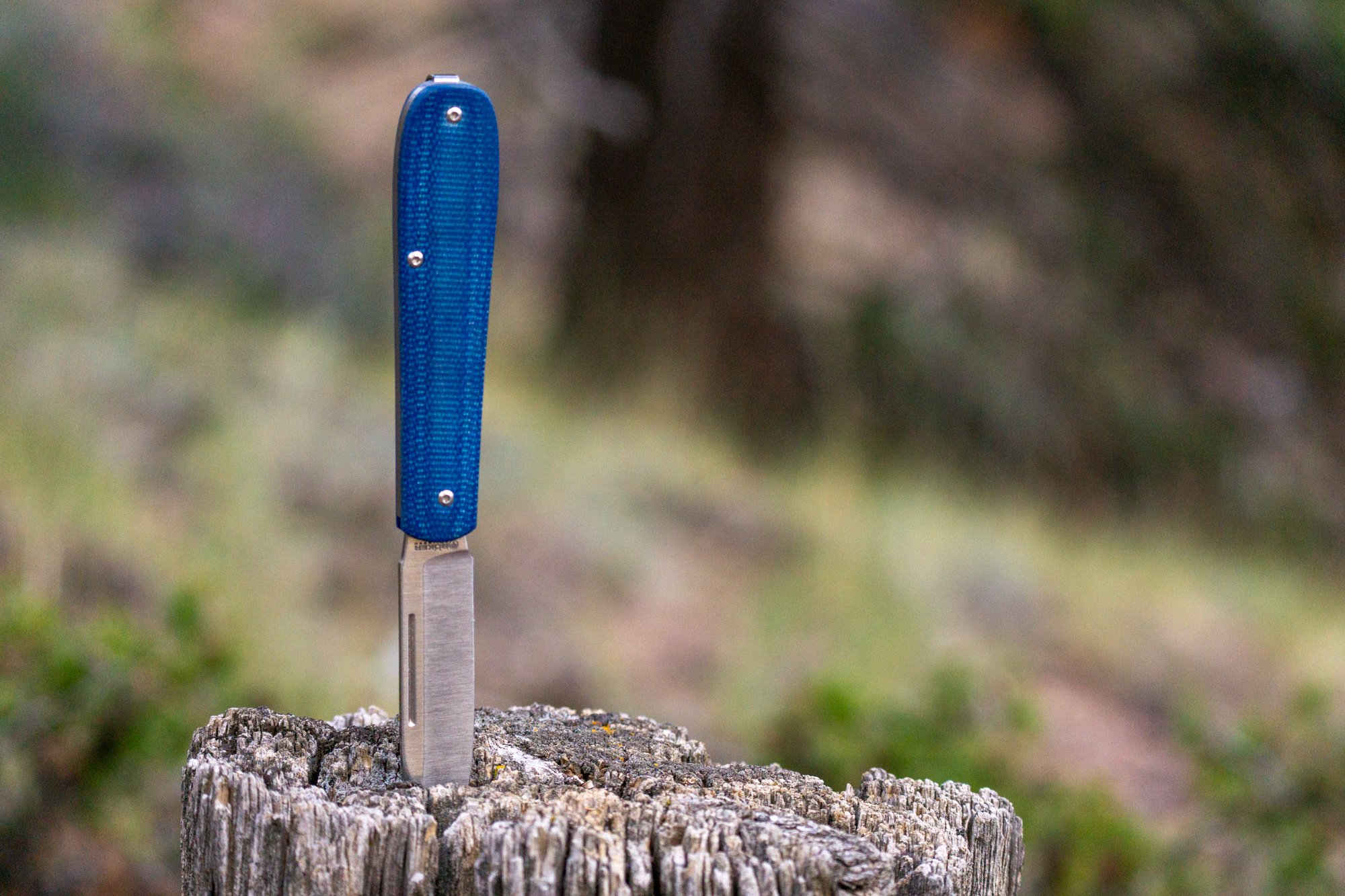
The handle shape is the entire personality of this knife. Custom maker Chuck Gedraitis drew a coffin outline, wide in the middle and tapered at both ends, and Böker builds it in their Solingen factory with hand finishing.
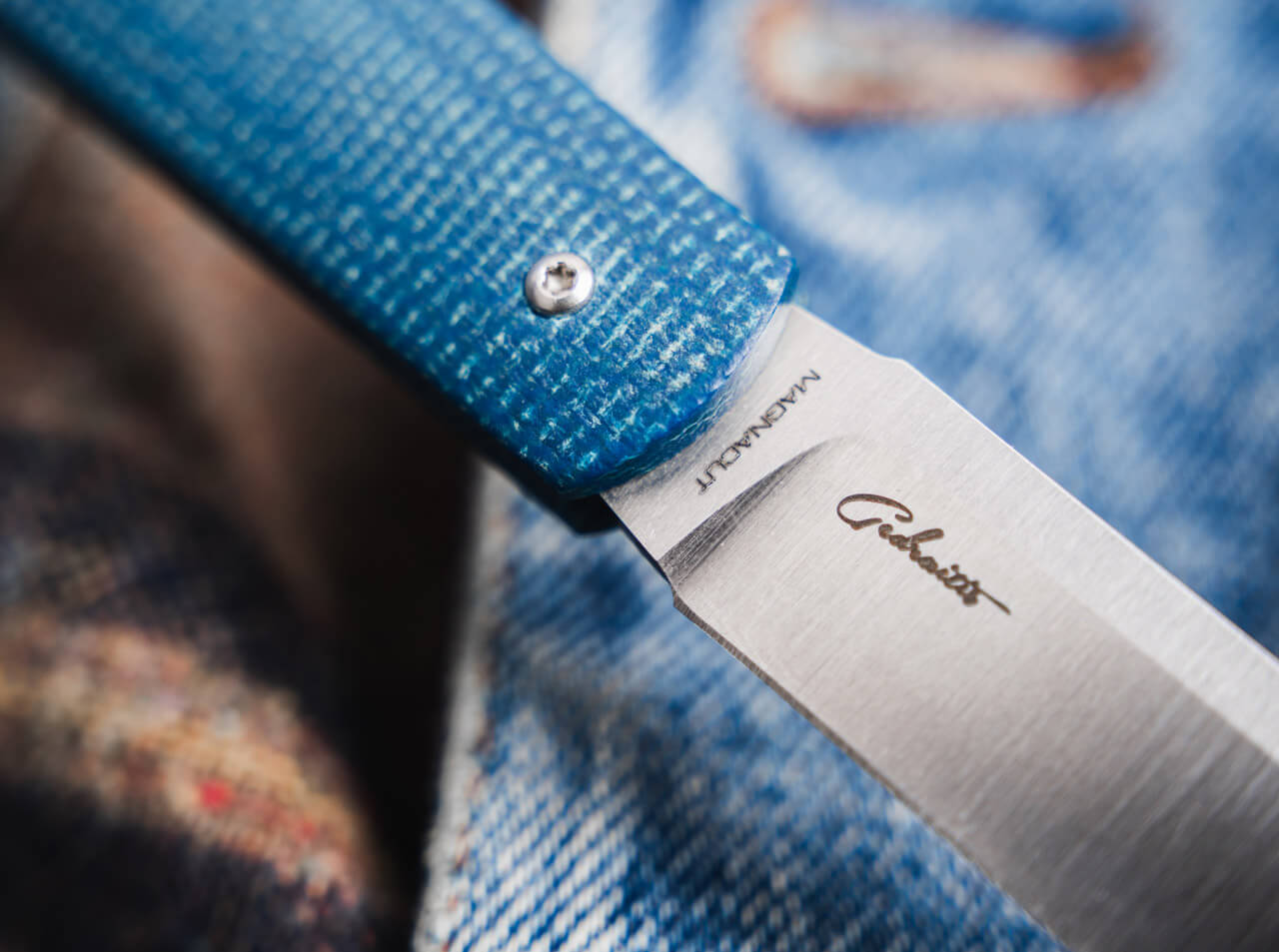
The denim Micarta is the other star. Micarta is layers of fabric set in resin, and this version uses actual denim, so you get a faded-jeans blue with visible weave. It’s warm in the hand, grippy when wet, and I would expect it to age well. Reviews report it will darken a bit with pocket oils and handling, which most Micarta fans consider a feature. The blade has a refined ricasso, the flat, unsharpened section just ahead of the handle. It gives your index finger a natural place to rest when you choke up for detail cuts.
A Little History: from Sheffield to Solingen
The Coffin and Slipjoint combination carries about 350 years of pocketknife history in a 2-ounce package. The slipjoint mechanism showed up in England around the mid-1600s. Scholars and merchants used these small folders to trim quill pens, which is where the word “penknife” comes from.
Sheffield, England, turned it into an industry. Large-scale cutlery production there was underway by 1700, and the backspring stayed the dominant folding-knife design for the next three centuries. Classic patterns like the Barlow date from that era.
The coffin shape has its own lineage. The coffin jack is thought to be one of the earliest jack-knife patterns, a Sheffield design from the mid-1800s. Some collectors also call it a crown jack. The same tapered-at-both-ends profile shows up on frontier-era Bowie knives, where the handle pins earned the nickname “coffin nails”. The shape stuck around because it works: the swell fills your palm, and the taper locks your hand in place.
American cutlers ran with the slipjoint from the 1850s into the early 1900s, naming dozens of patterns along the way. Böker has been part of that story since 1869, building knives under its tree-brand mark in Solingen, Germany’s “City of Blades.” So this knife is a fitting full circle: a 19th-century English pattern, redrawn by an American custom maker, and built in Germany with 21st-century steel.
The pattern is also having a moment. Strict knife laws in many places have pushed people back toward non-locking slipjoints, and makers are pairing the old mechanics with modern materials like MagnaCut and Micarta. This Coffin is a good example of that revival.
The Steel: MagnaCut on a Slipjoint
This is the real reason to look at this knife. Most traditional slipjoints run carbon steel or basic stainless. Böker went with CPM MagnaCut, a powder-metallurgy stainless steel designed by metallurgist Larrin Thomas and made by Crucible. MagnaCut’s claim to fame is balance. It holds an edge well, resists chipping, and is close to rust-proof. That last part matters on the road. Sweat, salt air, river crossings, and a week in a damp tent will put spots on a carbon blade fast. MagnaCut shrugs that off.
At 61–62 HRC, it’s on the harder end for this steel, so edge retention should be excellent. It still sharpens reasonably on diamond or ceramic stones, though not as quickly as softer steels. A small diamond plate in the glovebox handles touch-ups. The blade is 0.10 in thick. That’s slim, which means it slices cleanly through food and cordage. It also means you shouldn’t baton wood or pry with it. This knife pairs perfectly with a fixed blade like my current favorite Grizzly Knives Bighorn or Rachael’s EDC Exploro fixed blade.
Slipjoint Action: Old School on Purpose
There’s no lock here. A backspring holds the blade open under tension, and it’ll close if you push hard enough against the spine. That’s how pocketknives worked for a couple hundred years, and it’s fine for normal cutting. Keep your fingers clear of the edge and cut away from yourself, and it’s a non-issue.
You open it with a traditional nail nick, which takes two hands. It’s slower than a flipper or thumb stud. The trade-off is a slim, clean profile with nothing sticking out. Using the nail nick has been a rewarding experience for me. This knife reminds me of my grandfather using Case Trappers as a kid, and I’ve really enjoyed the nostalgia and slower pace. The 90-degree half-stop is a nice safety touch. Partway through opening or closing, the blade pauses at a right angle instead of snapping straight onto your fingers. It’s the kind of detail you appreciate the first time you close a knife with cold hands or you get in too much of a hurry.
Carry and Travel
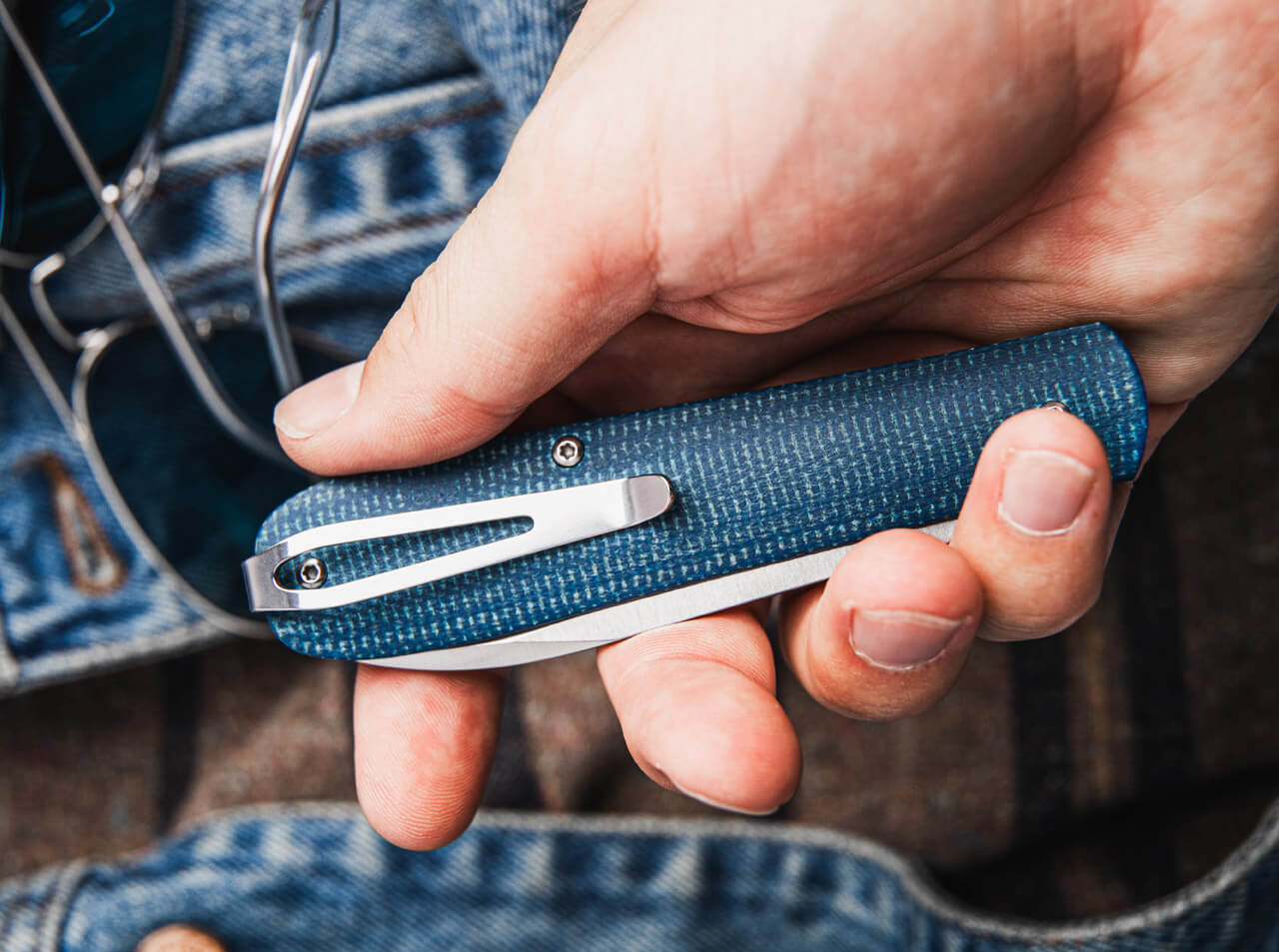
At 1.98 oz and roughly 4.2 in closed, the Coffin disappears in a pants pocket. The deep-carry clip rides tip-up and can be swapped to either side. Most traditional slipjoints have no clip at all, so this is a real practical upgrade. If you prefer it loose in a pocket or in the included felt case, you can pull the clip.
The non-locking, two-handed design is a quiet travel advantage. Some places restrict knives that lock or open with one hand. Germany, for example, bans public carry of locking one-hand-opening folders, but a two-handed slipjoint like this is generally fine. The UK allows non-locking folders with a cutting edge under 3 in. With a 3.15 in blade, this one is borderline, so check before you go.
Knife laws change and vary by city, state, and country. Always research local rules before you cross a border, and never put it in your carry-on. Rachael has a now-$350 pocket knife that cost $25 when new-it’s a sentimental item, and she has had to ship it home multiple times via TSA.
What Could Be Better
- Price: About $150 is a lot for a single-blade slipjoint. You’re paying for MagnaCut, German hand finishing, and a custom-maker design. A Böker Treebrand slipjoint in carbon steel runs well under $100.
- Two-handed Opening: If you’re used to a thumb stud or flipper, the nail nick will feel slow, especially with gloves on.
- No lock: Fine for everyday tasks, but not the knife for heavy, twisting, or stabbing cuts.
- Thin blade: Great for slicing, not for camp chores like splitting kindling. Pair it with a fixed blade or hatchet for that.
Our Final Verdict
The Böker Coffin Denim Micarta is one of the most practical ways to carry a traditional slipjoint today. MagnaCut fixes the old complaints about rust and dull edges. The clip fixes the old complaint about where to put it. And the denim Micarta makes it a knife you’ll actually want to pull out at camp. I have found the knife to be almost as much of a conversation piece as pulling out an Opinel at camp.
Böker Coffin Denim Micart on Amazon
Buy it if: you want a light, low-key everyday knife that handles weather and travel, and you appreciate a traditional design.
Skip it if: you need one-hand opening, a lock, or a beater blade for rough camp work.
For overlanders who want one good little knife riding in their pocket to the trailhead or around the world, this one is easy to recommend.